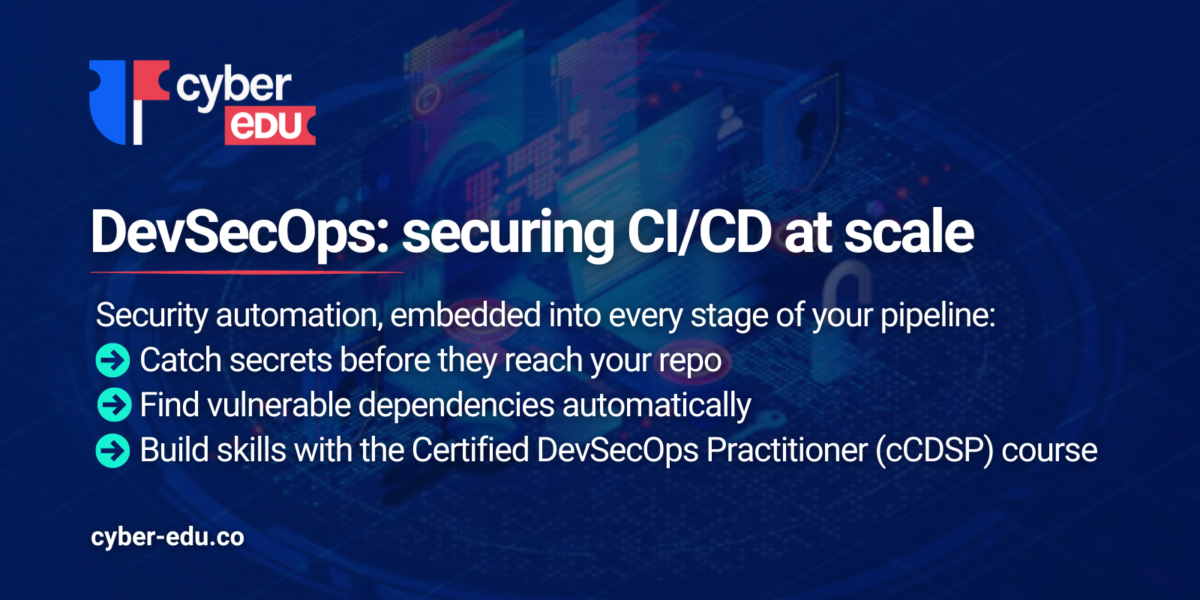
 Imagine a developer accidentally commits an API key. Without automated secrets detection, that key lives in your git history until someone notices… which may be never.
Or, perhaps, a dependency update pulls in a transitive vulnerability three levels deep in the package tree. No human reviewer is realistically catching that on a Friday afternoon.
Or, maybe, a Terraform change opens an inbound port in staging, which then gets promoted to production. The code review focused on application logic. Nobody looked at the network rules.
Unfortunately, these are by far no exotic attack scenarios. They are the ordinary failure modes of teams moving fast without security automation, and they happen constantly.
 Automation handles volume, consistency, and speed. It surfaces findings, it enforces gates, and it keeps the signal flowing.
However, it does not replace the security engineer who spots a flawed trust boundary in a system design. Nor does it replace the developer who asks “should we even be storing this data?”
Automation does not replace the culture that treats security as a shared responsibility rather than someone else’s problem.
The goal of DevSecOps automation is to remove friction from doing the right thing, so that human judgment can focus on the problems that actually need it, rather than being spent manually reviewing dependency trees.
 The Certified DevSecOps Practitioner (cCDSP) by CyberEDU is a hands-on program designed for developers, security engineers, DevOps practitioners, and anyone who wants to integrate security meaningfully into how software gets built.
You will go beyond the theory, working with real tools, real pipelines, and the kind of practical judgment that makes the difference between a checkbox exercise and an actually secure delivery process.
Prerequisites are low on purpose: basic SDLC knowledge and command-line comfort are enough to get started.