
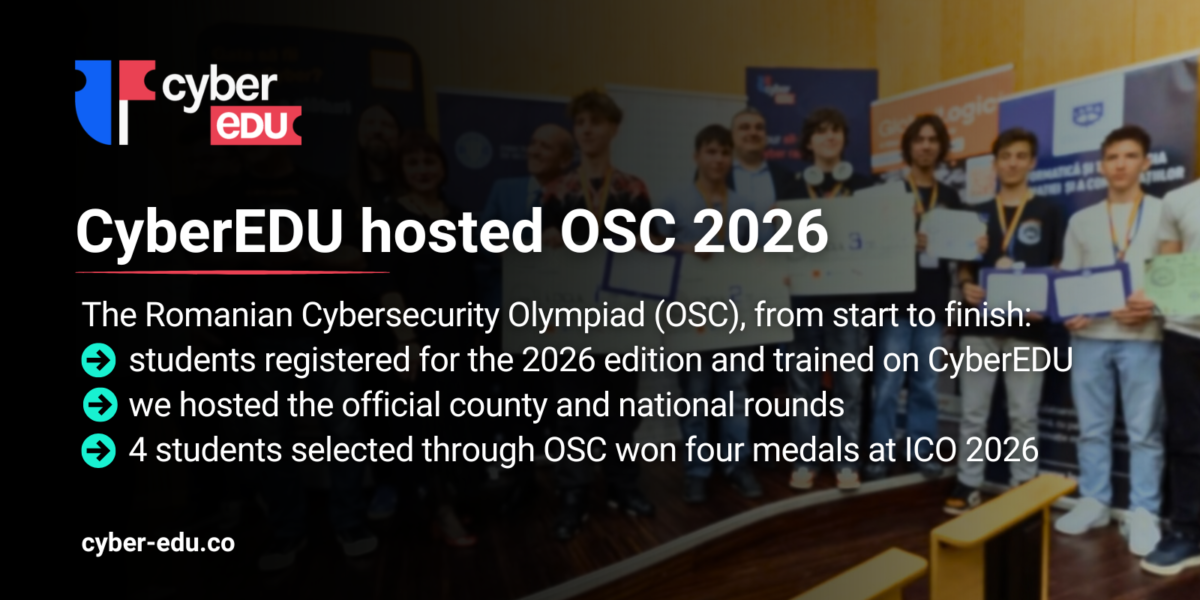
Four students brought home Romania’s first medals from the International Cybersecurity Olympiad (ICO) 2026. They qualified through the Romanian Cybersecurity Olympiad 2026, OSC for short, from its Romanian name, Olimpiada de Securitate Cibernetică.
OSC rests on a wider group of institutional and private partners. On the public side, the Ministry of Education and Research runs the competition, alongside the Romanian National Cyber Security Directorate (DNSC), the National Cyberint Center within the Romanian Intelligence Service, the Bucharest School Inspectorate, the National University of Science and Technology Politehnica Bucharest, and the University of Bucharest.
On the private side, Bit Sentinel and Orange Romania shaped OSC’s concept together, inside that same working group alongside the public institutions above. Bit Sentinel also built the CyberEDU platform that runs the competition today. The Romanian Association for Security Technology and ECDL Romania round out the private partners.
CyberEDU, the Romanian-built cybersecurity education platform, has hosted all three editions of OSC and continues to power the competition at every level, serving as the official platform for both the county stage and the national final.
What is the Romanian Cybersecurity Olympiad (OSC)?
OSC is a school competition for high school students passionate about cybersecurity. The Ministry of Education and Research organizes it, with support from DNSC.
The Ministry added OSC to the national school olympiad calendar in 2024, and 2026 marks the competition’s third year.
OSC 2026 ran in two rounds: the county round on April 24, and the national round between May 15 and 17. Students tackled fundamental cybersecurity concepts, applied cryptography, web, mobile and desktop application security, Open Source Intelligence techniques, log and network traffic analysis, reverse engineering, operating system and network configuration and security, and programming and scripting.
Moreover, OSC 2026 worked as Romania’s national qualifier for two separate international competitions: the International Cybersecurity Olympiad (ICO) and the European Cybersecurity Challenge (ECSC). Top finishers from OSC’s national round earned a spot on Romania’s national cybersecurity team, with a shot at representing the country at either event, as Financial Intelligence’s report on the 2026 national round laid out. ICO and ECSC run as two distinct competitions, each with its own delegation.
CyberEDU’s role in OSC
CyberEDU has officially hosted the Romanian Cybersecurity Olympiad since 2024, the year the Olympiad made its debut.
Organizers picked CyberEDU for this role because it already worked as an educational hub for high school and university students. By OSC’s first edition, the platform had run seven editions of UNbreakable Romania and five editions of the Romanian Cybersecurity Challenge.
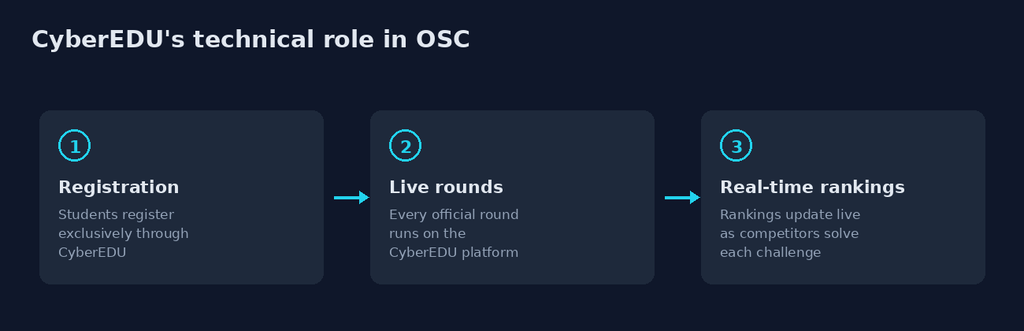
CyberEDU covers practically every technical stage of the competition: students register exclusively through the platform, the official rounds run on CyberEDU, and rankings update in real time as competitors solve each challenge.
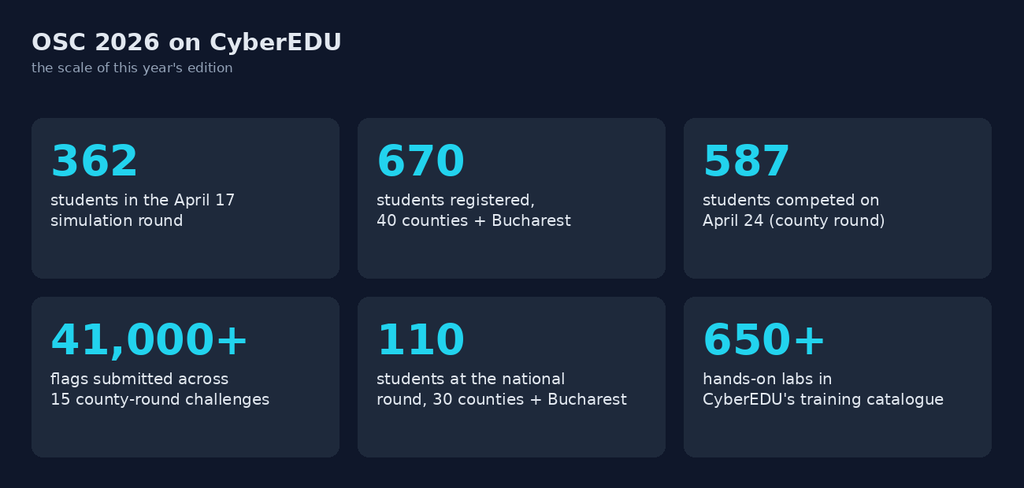
The 2026 edition showed the scale at which the platform now operates.
A simulation round on April 17 let over 360 students rehearse beforehand, and 670 students from 40 counties and Bucharest then registered for the county round. Of those, over 580 competed on April 24, submitting more than 41,000 flags across 15 challenges.
At the national round on May 16, 110 students from 30 counties and Bucharest worked through 13 challenges while rankings were updated live. Beyond the competition itself, CyberEDU gives students a catalogue of over 1,000 modules and challenges to train on.
What resources does CyberEDU give students entering OSC?
Students entered in OSC get access to resources on CyberEDU, built for their level of experience. Those who already competed in CTFs land in a space with advanced challenges, built to keep them sharp. First-time competitors get education modules that cover cybersecurity fundamentals and how a CTF actually works.
The platform also offers an Education Archive, stocked with over 1,000 hands-on labs mapped to industry standards such as MITRE ATT&CK, OWASP, and CWE, including past editions of the Romanian Cybersecurity Challenge. These exercises help students get familiar with the kind of problems OSC throws at them. Students can even set up their own Jeopardy CTF, using the same challenge sets as a team training exercise.
Registration for the county round runs directly on app.cyber-edu.co, and results for each stage update live throughout the competition.
How does CyberEDU keep OSC’s rounds fair for every competitor?
CyberEDU keeps OSC’s rounds fair through its own proctoring tool, CYE-SENTINEL, built specifically for CTFs and cybersecurity competitions that need supervision. The tool runs locally on each competitor’s device. It activates before the round starts and stays active for the round’s full duration, while organizers monitor participants through a dedicated dashboard.
The stakes are straightforward: without a solid proctoring mechanism, an online cybersecurity competition stays exposed to unauthorized collaboration or the use of banned tools. The OSC 2026 rules explicitly ban AI tools during the rounds, except where explicitly allowed for specific tasks. CYE-SENTINEL, CyberEDU’s solution for proctored CTFs breaks down how the tool works end to end.
Romania’s ICO 2026 delegation and its four medals
The four students who represented Romania at ICO 2026 won the country’s first medals at that competition: one gold, one silver, and two bronze, at Romania’s first official entry. The gold medal went to Iacob Răzvan Mihai, the silver to Albu Vladimir, and the two bronze medals to Filimon Ștefan Mihai and Stan Alexandru Gabriel.
ICO 2026 ran from June 27 to July 2 in Hammamet, Tunisia. It was the competition’s second edition, and it brought together high school students from dozens of countries. They competed in web application security, cryptography, digital forensics, reverse engineering, and vulnerability exploitation.
The four Romanian students were selected for ICO 2026 based on their results in the national round of OSC 2026. CyberEDU played a central role throughout this phase, hosting the national selection entirely on its platform and serving as the primary training environment through the Education Archive.
How should students prepare for future editions of OSC on CyberEDU?
Students who do well at OSC start on CyberEDU long before the county round opens, not the week before it. Here’s the shortest real path:
- Create your account on app.cyber-edu.ro the moment registration opens, and lock in your spot before your county’s deadline hits.
- Pick your lane. New to CTFs? Start with the education modules. Already competed before? Skip straight to the advanced challenge set.
- Raid the Education Archive for real problems from past Romanian Cybersecurity Challenge editions, so the Jeopardy format stops feeling unfamiliar on competition day.
- Run your own CTF with your friends, using the platform’s built-in tool. A fake deadline with real stakes beats studying alone.
- Fire up the proctoring tool 15 minutes early, then watch your ranking move in real time for the rest of the round.
Get ready for the next OSC edition!
If you’re a high school student drawn to cybersecurity, start training well before registration opens.
A free CyberEDU account gives you access to the education modules, the Education Archive, and the option to run your own CTF with friends.